
Note: As I continue to learn the Japanese language and culture, these Spotlight posts seek to highlight things I find curious, interesting, and meaningful. The relationship between language and culture runs deep. In fact, there are many points where it gets hard to tell one from the other. “Language is not merely an indifferent mechanism for cataloguing men’s experience but the language itself affects the cataloguing process…. The language system of each culture is a fluid factor in culture; it varies with each generation and serves as clue to its thinking as well as actually coloring and molding this thinking.” In other words, if I am going to learn how to reach Japanese people, I need to understand how Japanese people think. The process of how they think is intimately intwined with the language they use. Unfortunately for us, it goes far beyond simply using “Google Translate” to come up with the right vocabulary. Language embeds the foundational concepts of culture into everyday interaction. So, deeper we go into this wonderful world of language exploration! Much of this information comes from Charles Corwin’s Biblical Encounter with Japanese Culture (Tokyo, 1967).
To those of us raised in the west, Japan can often appear to be very homogeneous. The people are all the same. Their customs are based on long-held and unchanging traditions. There is a lack of diversity (as compared to other places) and the Japanese seem to cherish it. I hear again and again how Japan is monolithic in its tendency to prefer conformist practices and that I need to get used to feeling like an outsider. While there is a strong push in this direction overall, reality is much more nuanced and varied.
The closer one gets to the Japanese, the more these variations become evident. We watch a lot of programming on NHK-World. It is the English-language streaming service produced by Japan’s public broadcaster NHK. Now, I am fully aware that the selection of shows and topics presented are highly curated toward showing a version of Japan that is a little more polished than otherwise experienced. However, even within these parameters one can find a great variety of individual stories, preferences, and experiences. Human nature, after all, didn’t skip the Japanese people. They just show it to the outside world a little differently than other cultures.
Our word for this Language Spotlight is eien, which translates to eternity. As with most of these studies, it isn’t a fully accurate translation though. Japanese concepts of eternity are different than those found in the west. Additionally, this word also highlights one of the rare moments where competing ideas seem to occupy the same space. The kanji for eien consists of two characters: the one for “long” and the one for “far”. There are also echoes of “water” and “river” in the kanji for “long”, which evokes images of a long river that gets ever wider as it progresses downstream.
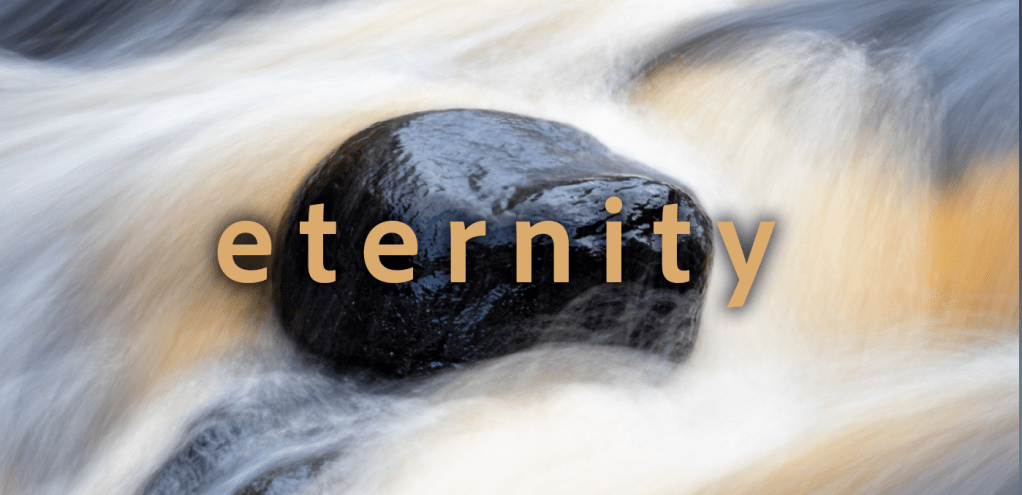
The Japanese concept of eternity, though, is not really concerned with the length of the river. Rather, it might be better understood as a rock that sits fixed in the riverbed, unmoving and unchanging, while the water continuously swirls around it. Most Japanese people, when referring to eternity aren’t trying to reference a concept related to time. Instead, they are drawing upon the notion of “changelessness”.
Here is where we find our rare occurrence of non-conformity. The concept of changelessness runs directly counter to the key Buddhist teaching of impermance. To Buddhist thought, everything is always changing. Nothing remains constant – even for a moment. How the Japanese hold these two positions together, I still don’t readily understand. One key might be their tendency to identify the divine within nature.
For Christians, eternity is not bound by our current understanding or experience. God is described as eternal because He is not subject to the limits of time. His love is everlasting (Jeremiah 31:3), as is His covenant (Jeremiah 32:40), His righteousness (Isaiah 51:6), His salvation (Isaiah 45:17), and His word (Isaiah 40:8). Zechariah makes clear to us that it is man who is mortal while God is everlasting.
If the ultimate in Japanese thinking is trapped within the confines of our experienced world and so measures eternity through the lens of impermanence, then at best man can only hope for being situated in that riverbed like a stone, unmoving and unchanging, while the waters of life rush around him. On the other hand, the Bible places God and those united to Him by faith in an eternal state. More than just duration or changelessness, it is a transcendent dimension outside of the bounds of time.
It is this other dimension that we look forward to!
~ Clay

 Fowlers in Japan