
Focusing on Thanksgiving

Psalm 118 is a psalm of Thanksgiving. It’s chief aim is to give praise to God for all he has done. If you have spent much time in Scripture, there are a number of phrases in this text which might “tickle your ears” a bit.

  • “His love endures forever”
  • “The Lord is my strength”
  • “I will enter and give thanks to the Lord”
  • “The stone the builders rejected has become the cornerstone”
  • “Blessed is he who comes in the name of the Lord”

Keep these phrases in the front of your mind as we dive in to what this Psalm has to share with us.

For the Israelites, this Psalm recounts the time of the Exodus when Israel was in distress. At just the right time, God rescues Israel and with His mighty hand brings peace to the people once more. That pivotal event is definitely in this psalm – but the language the Psalm uses points to a broader understanding of God’s rescue. More than merely relating the events of the Exodus story, Psalm 118 expands this idea beyond this single crisis. The psalmist is going above and beyond to make sure that you come away with the feeling that God’s love has always been there and will continue to be there forever. 

This Psalm is part of a group of Psalms that go together, known as the “Egyptian Hallel.” In fact, Psalm 118 is the concluding psalm and the climax of the series. 

  • Psalm 113 praises God as the one who reverses the status of the poor, lowly, and needy.
  • Psalm 114 tells the story of the Exodus and how God’s rule enters the world.
  • Psalm 115 contrasts how God helps Israel with how other gods treat the rest of the nations.
  • Psalm 116 expresses thanks to God for saving them from death.
  • Psalm 117 calls on the rest of the nations to praise the Lord.
  • Psalm 118, then, sums up all the others and announces that Israel exists to praise God before all the earth.

Today, we usually think of the Passover in just one of two ways. Either we recall the actual event in Egypt with the blood on the door and the angel of death, or we think of the time when Jesus and his disciples got together for the Last Supper. For the Israelites, it is one of the most important festivals of the Jewish calendar. Up until the time the Temple was destroyed, it was a public, communal event that lasted one whole week. Many people planned a pilgrimage to Jerusalem timed specifically to make this festival. These six Psalms would be read – one each day – leading up to the final Passover meal and a reading of Psalm 118.

It was during this very Passover meal that Jesus applied verse 22 to himself. Jesus *is* the stone which the builders rejected, and crucified. But He is also the stone which God has made the cornerstone through raising Jesus from the grave. That’s important. It is central to our beliefs about salvation. But if we limit our interaction there, we miss a great deal of context and meaning. By identifying Himself as the ultimate fulfillment of verse 22, Jesus isn’t just pointing out facts. He is tying his own identity with that of the whole Psalm. This was a tried-and-true method of rabbinic teaching during the first century – the rabbi would recall a specific verse, and expect all of his disciples to recall the whole passage. Jesus is doing the same thing here.

All four Gospels record the account of Jesus’ triumphant entry into Jerusalem. He rides on a donkey and people are laying palm branches on the ground. Matthew, Mark, Luke, *and* John all make a point of telling us that these people were praising Jesus and giving him honor by quoting from Psalm 118, verse 26a! “Blessed is he who comes in the name of the Lord.” 

Psalm 118 is all about expressing Thanksgiving to God for rescuing His people. Jesus ties his identity to the rejected stone in this Psalm, and so is also saying that He is the “One who comes in the name of the Lord.” In doing so, Jesus is drawing out a whole trunkload of comparisons. By connecting the two specific dots of Himself and the rejected stone, He is wanting you to continue connecting the rest of the dots about who He is. What are all the things that this Psalm is about and how do they become so much more with this new perspective?

  • Jesus is the new passover lamb, sacrificed to save the people.
  • Jesus is the blood for the doorway, to turn away God’s wrath.
  • Jesus is the cornerstone for the kingdom which God is building.
  • Jesus is the one who comes in the name of the Lord, who brings God’s light to shine on all of us.
  • Jesus is the one who is not dead, but lives to proclaim what the Lord has done!
  • Jesus is the reason we can join in with Psalm 118 and give thanks to God for rescuing us!
  • Because His Love Endures Forever.

Because God has rescued us from our sin, we can live a life that is based on joy and thankfulness instead of despair or worry. The most important thing in life has already been taken care of. Sometimes we forget, though, and we despair or worry anyway. Think about your main outlook on life. Do you often find yourself consumed with worry? Are you able to relax and enjoy knowing that God has already rescued you? By returning to Psalm 118 often, and reading it with the ultimate fulfillment through Jesus in mind, we can give our worries to the Father, ask for His peace in our hearts, and ask Him to increase our Thankfulness. 

~ Clay

Museum or Studio?

I’m reading a book right now by Mark Scandrette, Practicing the Way of Jesus, in which he explores what it means to live in Christian community. Very interesting! He uses an illustration that caught my attention. You might know that I studied Visual Arts in college and spent a number of years as a full-time graphic designer, so I usually love a good art metaphor.

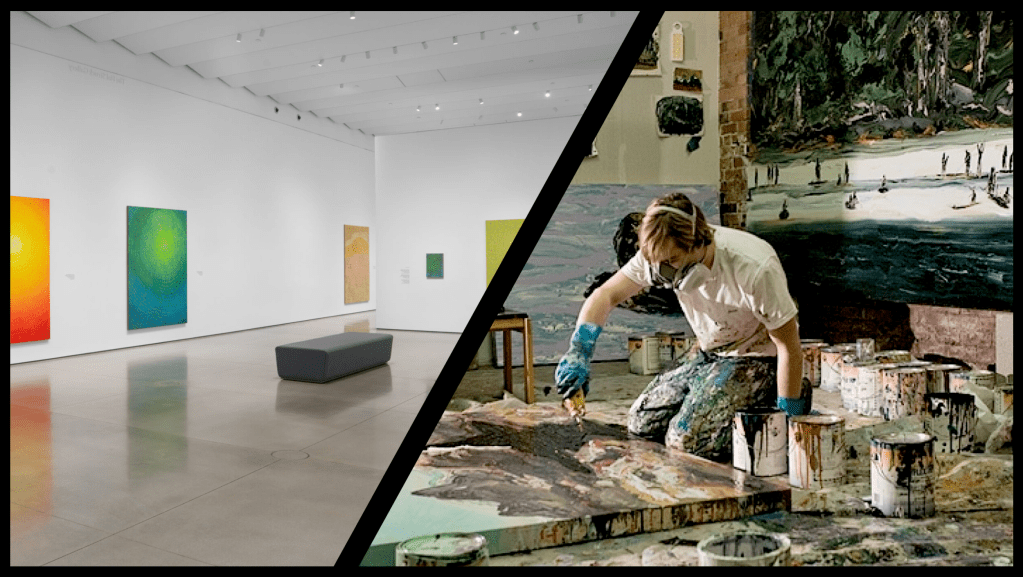
Scandrette points out that art museums are great places for preserving the history, culture, and values of a given culture or people. They are full of the crowning achievements of artists and artisans who worked long and hard to hone their skills. The order and serenity of a museum gives the featured works a sense of importance and meaning. The space serves to document the “conversation” that goes on between artists, art movements, and the overall exchange of ideas over time. Yet the clean white marble, the security guards, and the hushed atmosphere seem to be far away from the typical places in which all of that art was created.

In contrast, the artist’s studio can be a rather chaotic place. The apparent disorganization does have a purpose, though. Often times, artists are able to connect disparate ideas in creative ways precisely because they allow things to mingle which normally do not. The privacy and safety of an artist’s studio allows for tools to be exercised in new ways, for new ideas to lead to better ideas, and for emerging techniques to be tested and perfected. It’s where the artist is able to produce work which exemplifies their expertise and style.

Those who choose to follow Jesus Christ live in a similar tension between two spaces.

It is important to spend time “in the museums” of our faith. Limited as we are, we need regular reminders of how best to love as Jesus loves. Our buildings, our documents, our traditions, and how we organize our worship and congregations have all come down to us from those who blazed a trail before. We see their works as important and influential — and they are — but we cannot be content to just appreciate and admire them. Living solely in these museum spaces renders us ineffective. We choose not to harness the creative force of being an artist and instead simply look on as a spectator or worse, an art critic.

As Christians, we are called to also spend time “in the studio” of our faith. We must wrestle with ideas, try out new tools and techniques, and give ourselves permission to get a little messy in pursuit of drawing closer to Christ. It is a process that we all must go through. Considerable time spent in scripture and prayer can be fertile ground for hearing God’s own call on our lives. Through this “studio time” and the growth it brings, we are free to begin creating a faith that does more than just look at the masterpieces already hanging on the museum walls. We enter into that great conversation and begin contributing to the Kingdom ourselves.

In reality, we need to become proficient in both spaces. Each can interpret and inform the other! Each can even have direct influence on the other as well. Learn from those who have gone before, but get out there and get creative yourself as well. You’ll thank me later!

~ Clay

Hard to Reach: Japan

Recently, a fellow believer interested in Japan missions shared a series of short videos with us (thanks, Brandon!). I don’t have a great deal of experience with the Radical organization, or with their founder David Platt, but a cursory browse through their website confirms that we share many core beliefs. More critically, they have produced three short videos which summarize some of the core issues faced by Christian missionaries in Japan. I highly encourage you to give them a look!

Part 1 – Is Christianity Doomed to Fail in Japan? explores the religious history of Japan and its tenuous relationship with Christianity.

Part 2 – Why It’s So Hard to Leave Shintoism for Christianity explores why Shintoism and Buddhism are so intertwined with Japanese identity, and sits down with Japanese Christians to learn what that cultural challenge looks like today.

Part 3 – Japan is Broken… Can It Be Fixed explores how beauty and brokenness in Japan point to a Beautiful Creator who was broken for us.

I think this is a well-done series that excels at introducing some of the main challenges and opportunities of mission work in Japan. May God be glorified in Japan through the work of His people, and may He grant stamina and encouragement to those serving the kingdom in this way!

~ Clay

Summer 2024: June 3rd – July 15th

A quick update to say that our tickets are purchased and the trip is official! We will be traveling to Tokyo Monday, June 3, and returning to Memphis Monday, July 15th. Exciting!

There is still a good bit of work to do between now and then, so please keep us in your prayers as the details begin to fall into place. Please also keep praying especially that God is even now pricking the hearts of those who will come for English conversation or family music times. We thank God for each of you who continue to hold us close.

~ Clay

A Better Understanding

Emily Rachel and I recently attended Let’s Start Talking’s Basic Training. We hope to do some similar-type activities while we are in Japan this summer, so it seemed like a good chance for a refresher. We used the Let’s Start Talking materials years ago during our short-term mission campaign in college, so the chance to dust off some creaky corners of my brain was much appreciated.

One of the guiding principles in the LST program is to allow God’s Word to be the ultimate teacher. In fact, they discourage the use of the term ‘teacher’ at all. We are simply ‘workers’ who invite ‘readers’ to spend time building relationships. It’s the Word of God itself which will do the teaching. The LST program words it this way: The Word is the teacher, we are the illustration. I can appreciate the simplicity.

It truly is powerful, though, to think of it this way. In one sense, it takes all of the pressure off of us. It’s no longer up to us to ensure that someone else gets everything right. To be sure, we are a part of that process, but ultimately it is God’s responsibility. Through God’s Spirit, readers may come to know about His love, grace, and mercy. Through the timeless truths of His Word, they will encounter God’s message of Hope and Good News! Readers simply have to reach for it and read with an open heart.

In another sense, though, being the illustration instead of the teacher requires a much deeper sense of commitment. As a teacher, one can merely deliver great instruction. Living as an illustration means that each part of our lives must line up with the teachings we claim to illustrate. No one will do this perfectly. We fail time and again to properly illustrate the teachings of Jesus. It is important that we are transparent about these times.

But oh, what a powerful testimony being the illustration is. When someone reads the teachings of Jesus in scripture, their heart will be convicted. When they see those same teachings applied in our lives, they will be inspired to give it a go themselves. May our lives be ever-closer to an image which shows off God’s love and mercy! I pray that you draw encouragement from the Word, and that you strive to make your life an illustration of it’s truth.

~ Clay

Summer 2024 – In More Detail

For those who like to know more….

We have made a presentation to several Missions Committees in recent weeks which outlines in greater detail the specifics of our coming trip to Tachikawa in Summer 2024. Now, we have put together a “PDF Version” of this presentation for those who weren’t able to attend those meetings and for others who might find the added info meaningful.

Thank you for your encouragement and support as we seek to do God’s work in Japan!

~ Clay

Jump to the Week 1 Report –>

Summer 2024 Update – Blessed!

Thank you to so many who have encouraged Emily Rachel and I these past few weeks. Fundraising is never fun for me, but meeting with people and talking about how we can partner together to make a difference in Japan is something else entirely. I’m choosing to frame these meetings as the latter rather than the former. To date (January 2024), we are very close to being fully funded for this Summer!

In reality though, the difference between fundraising and partnership is not just semantics. You have a very real role in this work even though you aren’t likely to physically be coming with us on the airplane. The dollars are important, true. Without them, we would not be able to consider going at all. But they are not the most important way you lift us up.

What we really value is your prayer! Prayers for our preparation, prayers for those who we will meet when there, prayers for the Tachikawa members as they prepare for our arrival, prayers for the future interactions between seekers and church members, prayers that the evil one will be thwarted in whatever plans he is making, and any number of other ways that you remember us before the throne of our Lord.

We are beyond humbled and grateful for the way you show the love of Jesus to us and through us. It’s a partnership which we are blessed to be a part of. Thank you!

Summer 2024 is happening!

We are excited to share that we are planning to be in Tokyo next Summer!

The Tachikawa Church of Christ has invited Emily Rachel and me for a six week short-term mission trip. We’ll be helping them by providing outreach through English study for adults and music classes for young families. I’ll be preaching some on Sunday morning, and we hope to be an encouragement to the brothers and sisters there and enjoy the fellowship of believers.

We are making preparations and could use your help. Travel costs are significant, so every dollar helps. The Church of Christ at White Station in Memphis, Tennessee, has agreed to coordinate our mission fund, so if you are able to donate financially, please do so here.

Thank you to all of you who are so encouraging to us with prayers, notes, and comments. We love you!

~ Clay