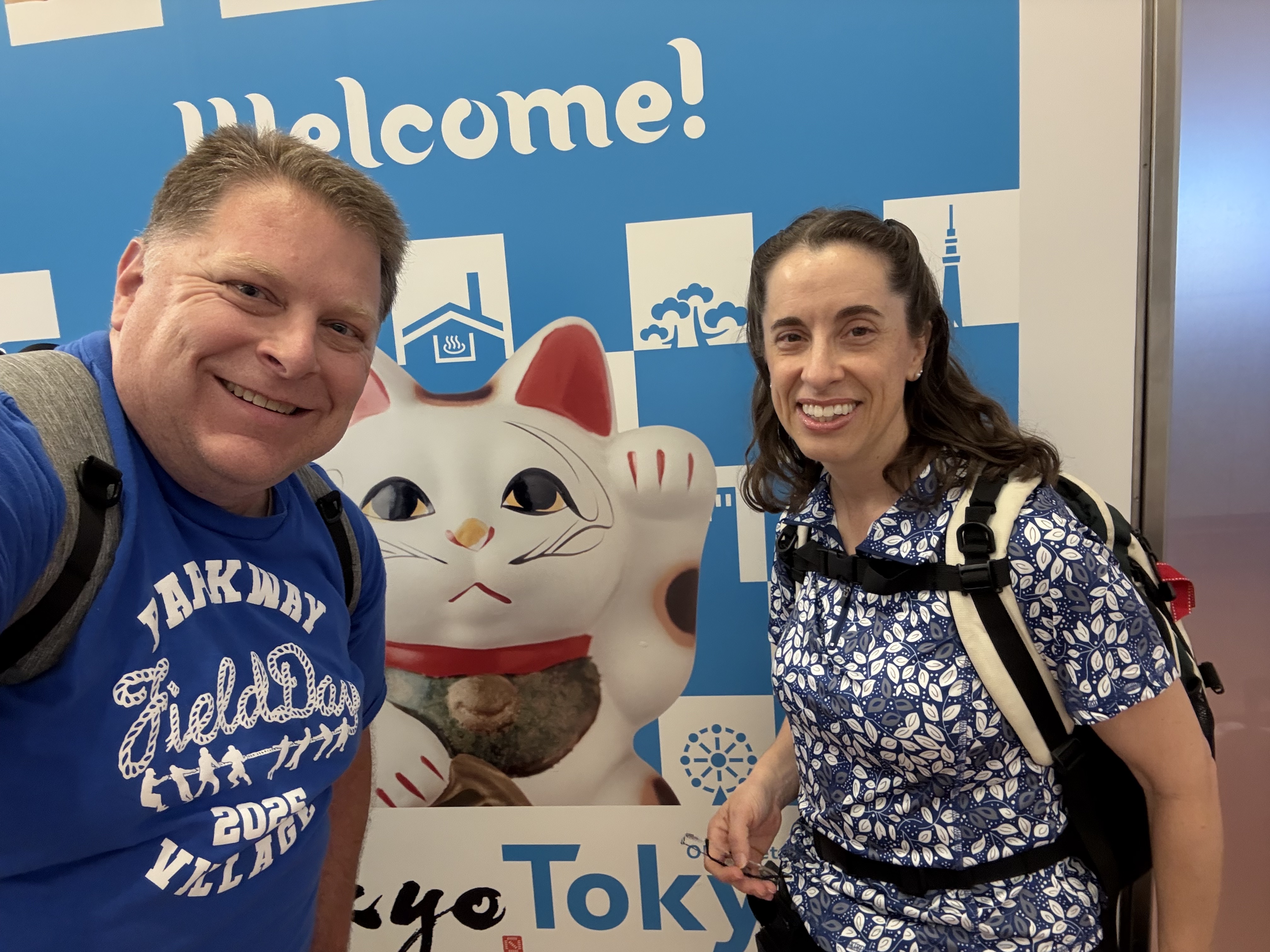
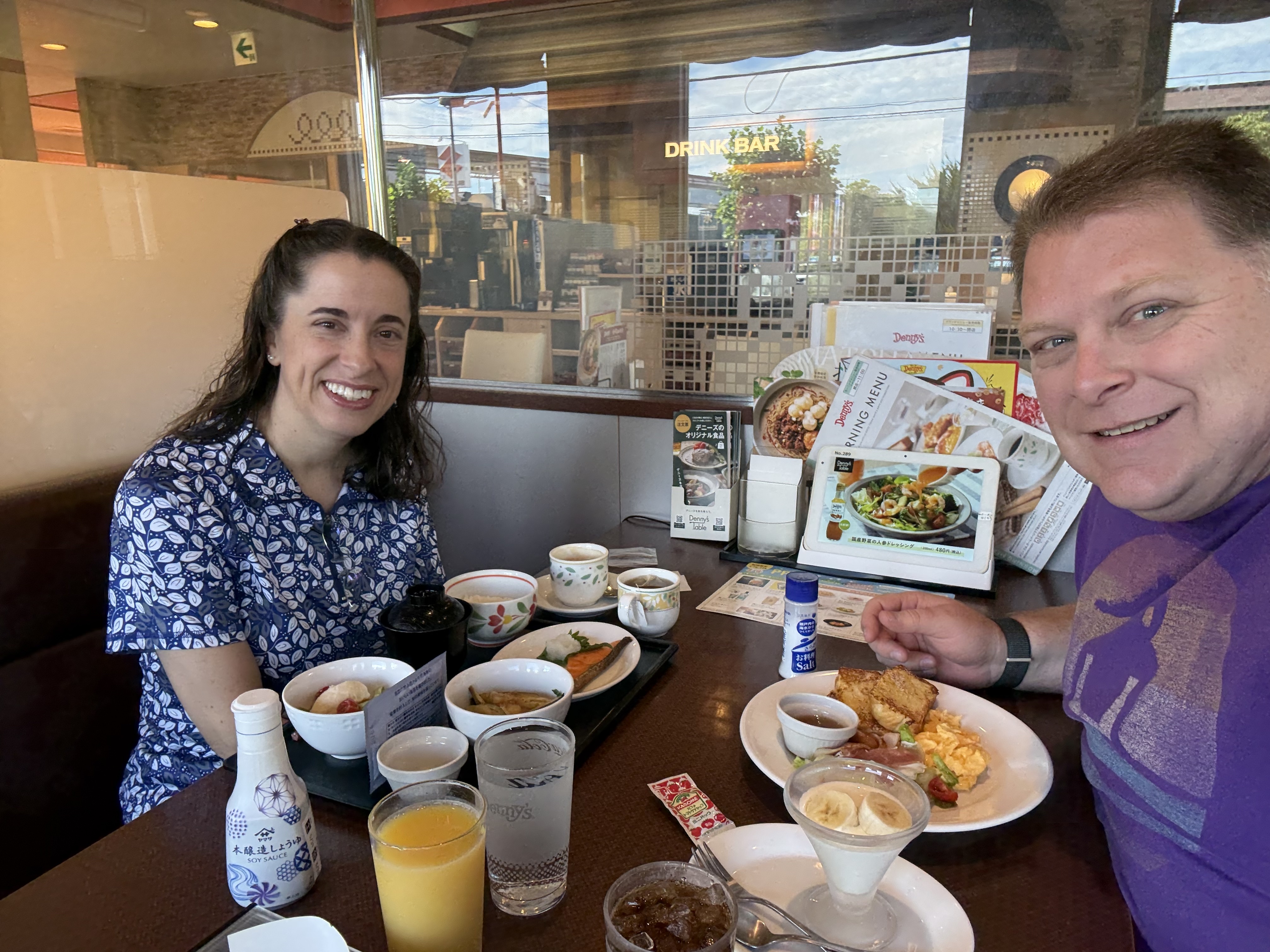
Just a quick post to let everyone know we have arrived in Tachikawa. Travels went smoothly (if not tiring!) and we woke up this morning to bright sunny skies. We started off right with a leisurely breakfast at Denny’s, and will take most of today to unpack, settle in, and manage the effects of jet-lag.
Thank you to everyone who is praying for our trip! We really feel like we aren’t here by ourselves, but that you all are along for the ride as well. These next six weeks will be great!
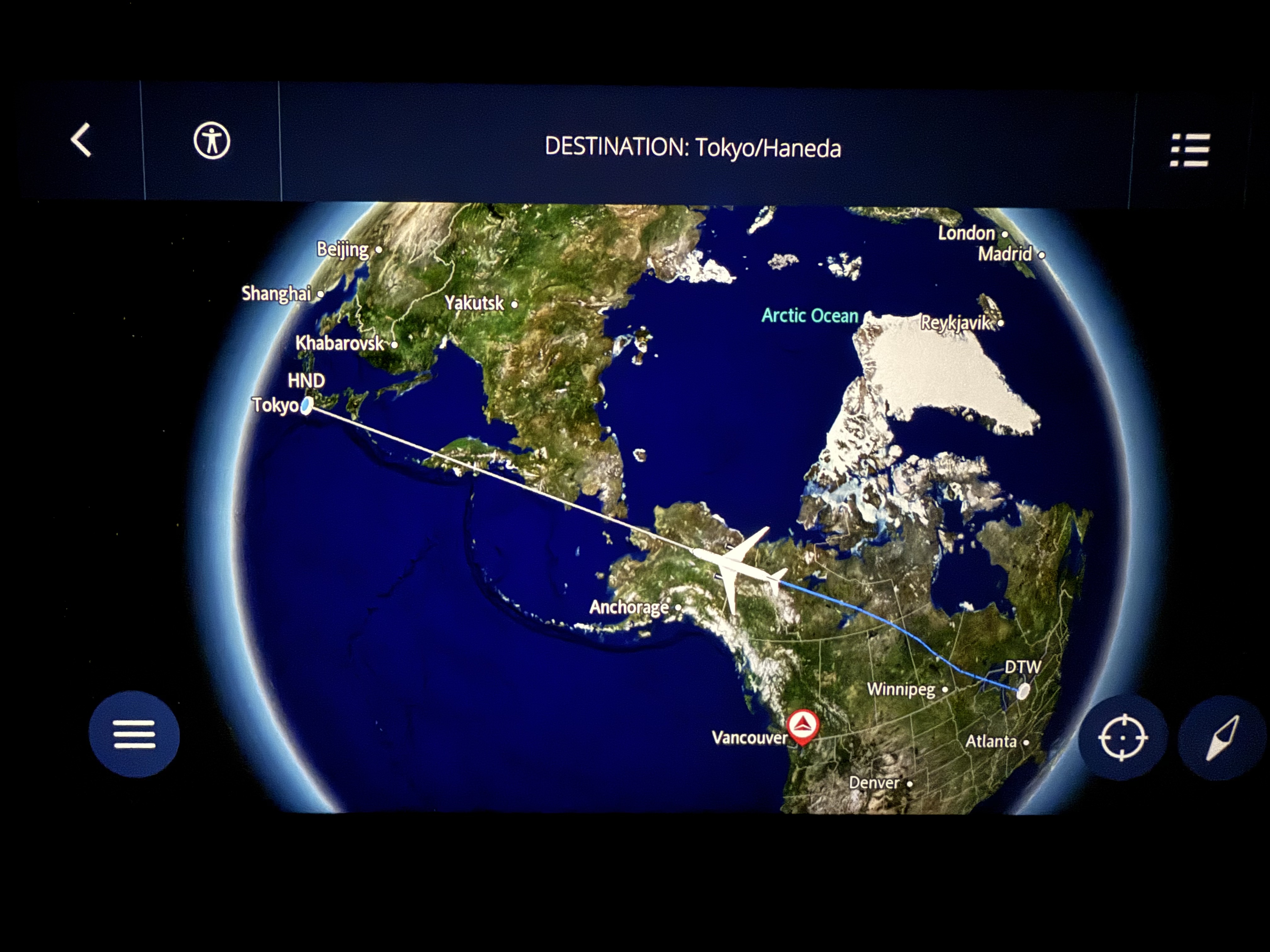
We gotta set our clocks early for this one. Monday morning (June 2) we will set out for the airport in Memphis at 4:30am. I’m yawning just thinking about it! We have a 6:30am flight to Detroit, then we will hang around a little over 4 hours before getting on board the flight to Haneda Airport (Tokyo). We should be in the air about two hours for the first leg, and then 13 hours for the big jump across the Pacific. After passing customs, we’ll have a bus ride of about 1.5 hours to get to Tachikawa where we will meet our ride. By the time we arrive, it’ll be Tuesday evening local time. Sounds easy, right?!
We are grateful for all of you who have mentioned you’ll be praying for safe travels. It is through the grace of God that we are able to make such a trip, and we hope that everything we do will ultimately glorify Him alone. We look forward to encountering people and showing them a glimpse of how much God loves them. Thank you to each of you who have helped fund this trip and for those of you who continually pray on our behalf.
The next post should be from the land of the rising sun!
Note: As I continue to learn the Japanese language and culture, these Spotlight posts seek to highlight things I find curious, interesting, and meaningful. The relationship between language and culture runs deep. In fact, there are many points where it gets hard to tell one from the other. “Language is not merely an indifferent mechanism for cataloguing men’s experience but the language itself affects the cataloguing process…. The language system of each culture is a fluid factor in culture; it varies with each generation and serves as clue to its thinking as well as actually coloring and molding this thinking.” In other words, if I am going to learn how to reach Japanese people, I need to understand how Japanese people think. The process of how they think is intimately intwined with the language they use. Unfortunately for us, it goes far beyond simply using “Google Translate” to come up with the right vocabulary. Language embeds the foundational concepts of culture into everyday interaction. So, deeper we go into this wonderful world of language exploration! Much of this information comes from Charles Corwin’s Biblical Encounter with Japanese Culture (Tokyo, 1967).
Whether they are practicing Buddhists or not, Japanese people are deeply influenced by Buddhist thought through fundamental ideas held at the core of Japanese culture and society. This word for love (“ai“) is no different. Buddhism sees a dichotomy between loves that are either “defiled” or “undefiled.” Essentially, the difference boils down to whether the object of a person’s love is desired for selfish or selfless reasons. Desire for fame, wealth, carnal pleasure, or a general lust for life fall into the defiled idea of love in Buddhist thought. Buddhists see these sorts of self-pleasing desires as working against an individual’s progress toward detachment and enlightenment, the primary goals of Buddhist practice. Undefiled love, then, is characterized by selfless compassion for all sentient beings. In practical terms, however, most behavior falls into the first category so Buddhist scholars generally list “ai” among the catalogue of Buddhist sins.
The Christian concept of love is very different. The greek language of the New Testament employs several words that could be translated as love. Eros (sexual love), philia (friendly affection), stergo (family affection), philadelphia (love between brothers and sisters), philanthropia (love for humanity), and agape (love expressed in action). The New Testament writers chose to focus on the word agape and infuse it with additional meaning to present the astounding message that God’s love is above and beyond what humans typically express toward each other. Christ brought a new order, a manifesto of love. He not only declared that this was the supreme criterion in life but by His life and death showed that this love is intrinsic to the very nature of God. This is the endearing, sacrificial, pardoning love of God which moves out to embrace sinful men.
Modern usage of the Japanese “ai” tends to focus more on the ideas of “compassion” or “fondness” rather than what we in the West would consider the deeper meaning of love. Even so, it is not often used. In truth, so many varied concepts of Japanese affection are conveyed by the word “ai” — compassion, desire, eros, regret — that it has become unwieldy for the average Japanese person. Up until the Edo period, the Japanese language developed through Imperial court literature. In such surroundings, the slightest expression of innuendo, the mere glance of the eye, the wave of the hand in guarded moments were keys unlocking unseen vaults of human emotion. Buddhist frowning upon any human endeavor which released craving, desire, or passion furthered this dampening of affections.
Even today the word “ai” ( as in the forthright expression “I love you”) is too outright. Rather, the young suitor will tell his lover “I am fond of you” (anata ga suki desu). This is all she needs to know; he has told all. The kanji character of “heart” in the word fixes it in the mind’s eye as a human emotion springing from man towards a desired object. It expresses desire for possession and at the same time a regretting, since failure to possess or parting is man’s common experience.
What sets Biblical love off from Japanese ai is the contextual use of the Greek agape expressing a Divine love that soars above the human plane. It is a love which manifests itself in determined, one-sided acts of salvation, pardon, adoption, faithfulness toward the unlovely, undeserving, and unfaithful.
Japanese ai is reaching out to possess; Biblical agape is God’s reaching out to redeem.
“Do not let your hearts be troubled. You believe in God; believe also in me. My Father’s house has many rooms; if that were not so, would I have told you that I am going there to prepare a place for you? And if I go and prepare a place for you, I will come back and take you to be with me that you also may be where I am. You know the way to the place where I am going.” Thomas said to him, “Lord, we don’t know where you are going, so how can we know the way?” Jesus answered, “I am the way and the truth and the life. No one comes to the Father except through me. If you really know me, you will know my Father as well. From now on, you do know him and have seen him.” Philip said, “Lord, show us the Father and that will be enough for us.” Jesus answered: “Don’t you know me, Philip, even after I have been among you such a long time? Anyone who has seen me has seen the Father. How can you say, ‘Show us the Father’? Don’t you believe that I am in the Father, and that the Father is in me? The words I say to you I do not speak on my own authority. Rather, it is the Father, living in me, who is doing his work. Believe me when I say that I am in the Father and the Father is in me; or at least believe on the evidence of the works themselves. Very truly I tell you, whoever believes in me will do the works I have been doing, and they will do even greater things than these, because I am going to the Father. And I will do whatever you ask in my name, so that the Father may be glorified in the Son. You may ask me for anything in my name, and I will do it. ~ John 14:1-14
This text is frequently read at funerals, and for good reason.
It contains promises that are profoundly comforting in the face of the death of a loved one. But this text is not only about life after death, this is a text that has everything to do with our lives here and now.
The setting is Jesus’ farewell address at his last supper with his disciples.
Jesus has washed his disciples’ feet and has explained to them what this means (13:1-20).
He has foretold his betrayal by Judas, and Judas has slipped out into the night (13:21-30).
He has told his disciples that he will be with them only a little while longer, and that where he is going, they cannot come (13:33).
He has also foretold Peter’s imminent denial (13:36-38).
No wonder the disciples are troubled. Their beloved teacher is leaving them, one of their own has turned against them, and the leader among the disciples is said to be on the cusp of a great failure of loyalty. It is as though the ground is shifting beneath their feet.
Jesus responds to the anxiety of his disciples by saying, “Do not let your hearts be troubled. Believe in God, believe also in me” (14:1). Jesus calls them back to this fundamental relationship of trust and assures them that he is not abandoning them. Rather, he is returning to his Father, which is good news for them.
In speaking of his ascension to the Father, Jesus assures his disciples that this is also their destination. There are many dwellings in his Father’s house, and he goes to prepare a place for them, so that they will be with him and dwell with him in his intimate relationship with the Father (14:2-3).
When Jesus says that they know the way to the place where he is going (14:4), Thomas, like most characters in the Gospel, takes Jesus quite literally. He wants directions, a road map to this place (14:5). Jesus responds by saying that he himself is the way: “I am the way, and the truth, and the life. No one comes to the Father except through me” (14:6).
Unfortunately, this verse has often been used as a trump card, or worse, as a threat, to tell people that they better get with the program and “accept Jesus as their personal Lord and Savior” in order to be saved. To interpret the verse this way is to rip it from its context and do violence to the spirit of Jesus’ words.
This statement by Jesus is a promise, a word of comfort to his disciples. Jesus himself is all they need; there is no need to panic, no need to search desperately for a secret map. Jesus adds, “If you know me, you will know my Father also” (14:7a).
The conditional phrase in Greek is a condition of fact, meaning that the condition is understood to be true: “If you know me (and you do), you will know my father also.” So that there can be no misunderstanding, Jesus adds, “From now on, you do know him and have seen him” (14:7b).
This time it is Philip who is not quite convinced. “Lord, show us the Father, and we will be satisfied” (14:8). Jesus’ response contains perhaps a hint of exasperation: “Have I been with you all this time, Philip, and you still do not know me? Whoever has seen me has seen the Father” (14:9).
Here Jesus echoes an affirmation from the prologue of John’s Gospel: “No one has ever seen God. It is God the only Son, who is close to the Father’s heart, who has made him known” (1:18). This is the whole of Jesus’ earth ministry, to make known the Father, to reveal who God is. Jesus, who has come from the Father and is now returning there, is the fullest revelation of the person and character of God. If we want to know who God is, we need look no further than Jesus. All the words that Jesus has spoken, all the works that he has done, come from God and show us who God is (14:10-11).
This passage has everything to do with life here and now because Jesus entrusts his mission to his disciples. “Very truly I tell you, the one who believes in me will also do the works that I do and, in fact, will do greater works than these because I am going to the Father. I will do whatever you ask in my name, so that the Father may be glorified in the Son. If in my name you ask me for anything, I will do it” (14:13-14).
Yet here is where Jesus’ promise becomes a little hard to swallow. Greater works than these? Really, Jesus? Greater works than healing the blind and raising the dead? And you will do whatever we ask in your name?
We have all known the pain of praying for healing that did not come, of feeling powerless in the face of disease and death. How can these promises be true?
Perhaps our problem is that in hearing these promises, we expect to do these greater works in the same way that Jesus did them — with miraculous power that instantly solves the problem at hand. Yet even miracles are not guaranteed to produce faith. Many in John’s Gospel who witness the “signs” that Jesus performs have trouble seeing the work of God right before their eyes.
Toward the end of John’s Gospel, Thomas sees the risen Lord and confesses, “My Lord and my God!” (20:28). Jesus responds, “Have you believed because you have seen me? Blessed are those who have not seen and yet have come to believe.” This is not so much a scolding for Thomas as a blessing for us who have not seen and yet believe, however feeble our believing may seem.
Jesus promises to be with us through the power of the Spirit, to work in and through us to accomplish his purposes in the world. This does not necessarily happen in easily visible, spectacular ways.
Yet wherever there is healing, reconciling, life-giving work happening, this is the work of God. Wherever there is life in abundance, this is Jesus’ presence in our midst.
“No one has ever seen God. It is God the only Son, who is close to the Father’s heart, who has made him known” (1:18). Jesus has made known to us the heart of God, and he has entrusted this mission of “making known” to us.
Think about who you interact with every day. Do you see Jesus working there? Maybe you have a friend who is going through some discouraging things right now. Could Jesus be showing you an opportunity to lift them up? Maybe there is someone who everyone seems to overlook, but you have a chance to include them in what you are doing. Might that be Jesus tapping on your shoulder?
Where might we see Jesus’ work and presence in our midst? How might we show others the very heart of God? Ask God to help you recognize how you can show His heart to others.
Note: As I continue to learn the Japanese language and culture, these Spotlight posts seek to highlight things I find curious, interesting, and meaningful. The relationship between language and culture runs deep. In fact, there are many points where it gets hard to tell one from the other. “Language is not merely an indifferent mechanism for cataloguing men’s experience but the language itself affects the cataloguing process…. The language system of each culture is a fluid factor in culture; it varies with each generation and serves as clue to its thinking as well as actually coloring and molding this thinking.” In other words, if I am going to learn how to reach Japanese people, I need to understand how Japanese people think. The process of how they think is intimately intwined with the language they use. Unfortunately for us, it goes far beyond simply using “Google Translate” to come up with the right vocabulary. Language embeds the foundational concepts of culture into everyday interaction. So, deeper we go into this wonderful world of language exploration! Much of this information comes from Charles Corwin’s Biblical Encounter with Japanese Culture (Tokyo, 1967).
To those of us raised in the west, Japan can often appear to be very homogeneous. The people are all the same. Their customs are based on long-held and unchanging traditions. There is a lack of diversity (as compared to other places) and the Japanese seem to cherish it. I hear again and again how Japan is monolithic in its tendency to prefer conformist practices and that I need to get used to feeling like an outsider. While there is a strong push in this direction overall, reality is much more nuanced and varied.
The closer one gets to the Japanese, the more these variations become evident. We watch a lot of programming on NHK-World. It is the English-language streaming service produced by Japan’s public broadcaster NHK. Now, I am fully aware that the selection of shows and topics presented are highly curated toward showing a version of Japan that is a little more polished than otherwise experienced. However, even within these parameters one can find a great variety of individual stories, preferences, and experiences. Human nature, after all, didn’t skip the Japanese people. They just show it to the outside world a little differently than other cultures.
Our word for this Language Spotlight is eien, which translates to eternity. As with most of these studies, it isn’t a fully accurate translation though. Japanese concepts of eternity are different than those found in the west. Additionally, this word also highlights one of the rare moments where competing ideas seem to occupy the same space. The kanji for eien consists of two characters: the one for “long” and the one for “far”. There are also echoes of “water” and “river” in the kanji for “long”, which evokes images of a long river that gets ever wider as it progresses downstream.
The Japanese concept of eternity, though, is not really concerned with the length of the river. Rather, it might be better understood as a rock that sits fixed in the riverbed, unmoving and unchanging, while the water continuously swirls around it. Most Japanese people, when referring to eternity aren’t trying to reference a concept related to time. Instead, they are drawing upon the notion of “changelessness”.
Here is where we find our rare occurrence of non-conformity. The concept of changelessness runs directly counter to the key Buddhist teaching of impermance. To Buddhist thought, everything is always changing. Nothing remains constant – even for a moment. How the Japanese hold these two positions together, I still don’t readily understand. One key might be their tendency to identify the divine within nature.
For Christians, eternity is not bound by our current understanding or experience. God is described as eternal because He is not subject to the limits of time. His love is everlasting (Jeremiah 31:3), as is His covenant (Jeremiah 32:40), His righteousness (Isaiah 51:6), His salvation (Isaiah 45:17), and His word (Isaiah 40:8). Zechariah makes clear to us that it is man who is mortal while God is everlasting.
If the ultimate in Japanese thinking is trapped within the confines of our experienced world and so measures eternity through the lens of impermanence, then at best man can only hope for being situated in that riverbed like a stone, unmoving and unchanging, while the waters of life rush around him. On the other hand, the Bible places God and those united to Him by faith in an eternal state. More than just duration or changelessness, it is a transcendent dimension outside of the bounds of time.
It is this other dimension that we look forward to!
What then shall we say that Abraham, our forefather according to the flesh, discovered in this matter? If, in fact, Abraham was justified by works, he had something to boast about—but not before God. What does Scripture say? “Abraham believed God, and it was credited to him as righteousness.” Now to the one who works, wages are not credited as a gift but as an obligation. However, to the one who does not work but trusts God who justifies the ungodly, their faith is credited as righteousness.
It was not through the law that Abraham and his offspring received the promise that he would be heir of the world, but through the righteousness that comes by faith. For if those who depend on the law are heirs, faith means nothing and the promise is worthless, because the law brings wrath. And where there is no law there is no transgression. Therefore, the promise comes by faith, so that it may be by grace and may be guaranteed to all Abraham’s offspring—not only to those who are of the law but also to those who have the faith of Abraham. He is the father of us all. As it is written: “I have made you a father of many nations.” He is our father in the sight of God, in whom he believed—the God who gives life to the dead and calls into being things that were not.
~ Romans 4:1-5, 13-17
In these early chapters of Romans, Paul is working his way through the issue of faith versus works. To help build his case he wants to take a look at Abraham in order to help us see the issue a little clearer.
The Jews put ALOT of emphasis on Abraham being their Father. They took pride in the fact that they were his descendants, and as such inherited these awesome promises from God. Scholars have pointed out that in many Jewish writings, especially from the first century, it was obvious that the Jews held up Abraham as not just their ancestor but also as a model of faithfulness to the law.
But Paul wants to draw some lines here.
He starts by quoting Genesis 15 — “Abraham believed God, and it was credited to him as righteousness.” A crucial phrase in this verse is “credited to him as righteousness”, but what does that mean? Some interpreters think that this phrase is trying to say that Abraham’s faith WAS a form of righteousness. In other words, Abraham believing God was in some way itself a righteous act. But Paul doesn’t say it that way. He says that Abraham was “credited” with righteousness. Without becoming overly technical, it is a way to say that Abraham is given a righteousness that does not inherently belong to him. When Abraham believed God, God granted him the status of “righteousness”.
Paul want to make sure we are clear on this, so he continues to explain in detail using the illustration about wages and gifts. This is a little confusing to our ears because of the phrasing that Paul uses, but one commentator laid it out this way:
When we “work,” an employer pays us wages not “as a gift” but “as an obligation”.
God is a God of grace, who always gives freely and without constraint. He can never be “obligated” to any person.
Therefore, God cannot “credit” human beings anything on the basis of their “works”.
The keys to understanding this correctly are the ideas of “gift” and “justifying the ungodly”. Paul insists throughout all of his letters that God’s grace is a gift. That one is pretty easy to get. This bit about God justifying the ungodly, though. We need to be careful about that one. One way many people have mis-applied this passage is to read that and come away thinking, “oh, I can do whatever I want!” It seems to suggest that Christians are “off the hook” going forward. After all, if Christ has already pleased God in our place, is it really all that important that we continue to please God as well in our day to day?
Paul will actually address that in more detail in Chapter 6, but for right now we just need to remember that you can’t take this snippet of a verse in a vacuum. Paul does argue that God makes us right with Him before we ever stop sinning, but he also says that God “regenerates” us and “sanctifies” us and causes His Spirit to dwell in us as well. God transforms us from within! This is how Paul (the faith guy) can agree with James (the works guy). A genuine Christian will always reveal the inward transformation through outward signs of a new life of obedience.
In verses 13-17, Paul restates the truth about Abraham’s righteousness. Then he takes it one step further. Remember, most Jews during Paul’s day taught that Abraham’s stature and role meant that he was in effect being obedient to the law of Moses. Paul wants to make clear that this ISN’T the case. First of all, Abraham preceded the law by more than 400 years. Paul will lean into this fact more in Galatians 3, but here in Romans, Paul sticks with the core meaning in the text. The promise to Abraham did not come because anyone obeyed the law, but “through the righteousness that comes by faith.” In other words, the promises of God come because of faith.
And here’s that next step Paul is taking. Paul says the promises apply to ALL of Abraham’s offspring. When God says to Abraham, “I have made you the father of many nations” he meant it in the physical sense. Abraham’s descendants will become Israelites, Ishmaelites, Edomites, Amalekites, Kenizzites, Midianites and Assyrians (among others). But Paul is saying that God meant that Abraham would be the father of many nations in a spiritual sense as well. In that sense, if we have the same faith that Abraham had, we are part of his spiritual offspring. And as part of his offspring, we can participate in the promises of God! So, FAITH IS A BIG DEAL for Paul.
Here are three big takeaways:
FIRST – Faith is distinct from the law. The law is something you DO. Faith, by contrast, is an ATTITUDE. It is a posture that we take that expresses a willingness to receive the GIFT that God wants to give us. In our world today, we measure everything with some form of achievement. Everything we do in school seems to be either graded, timed, or measured in some fashion. It doesn’t get much better when you get out into the work-world either. What title do you have, how many contracts did you sign, how many deadlines have you met, have you been promoted faster than your co-workers. Even our personal lives are achievement oriented. Do I have the latest electronic device? How many followers do I have on social media? How big is my bank account or how flashy is my car or how many rooms does my house have…. It goes on and on! We are so accustomed to living this sort of life that it can creep into our thinking when it comes to our relationship with God, too. Maybe that relationship has started to become based on what we are doing for Him instead of on what He has done for us.
SECOND – Faith itself has no power. Instead, the power comes from the one in whom we place our faith. Abraham recognized God as the one who has the power to deliver on His promises. It wasn’t Abraham’s faith that had that power, but it was the God in whom that faith believed who does. Sarah was barren. They had no children and they were already getting old and well-past the time when children were to be expected. Yet, God promised Abraham a son and Abraham believed He could do it. And He did. You and I with our faith really don’t have the power. Instead, we look to the power of God to fulfill the promises that He has made.
THIRD – Faith is based on God’s Word. It is not based on the evidence gathered through our senses. Again, Abraham had no reason to think that he would ever have a son – except that God SAID HE WOULD. Even when we don’t see how in the world God is going to pull this off, we remain strong in our faith that He will. Abraham was put to the test a little later when God ordered him to take Isaac (that son that was promised) and offer him as a sacrifice. Even then, Abraham had faith that God could still keep His Word and fulfill the promises. Having passed the test, God rescinds the order and provides a ram to sacrifice instead. Some people have described Faith as “a leap in the dark” but this isn’t really accurate. Abraham didn’t blindly or arbitrarily put his faith in God. Abraham had God’s word to hold on to even when it wasn’t clear how that word was going to work out. We have God’s word written in Scripture. We also have God’s living Word in the person of Jesus. We even have God’s Spirit dwelling inside us and if we listen He will guide our steps.
Faith can be hard to hold on to. Jesus talks about the Gospel being like seeds scattered. Some lands on good soil and grows. But some lands on rocky ground and the faith that grows initially doesn’t have deep roots and withers away when things get hard. Some lands among thorns and while their faith tries to grow strong, it gets choked out by worries and chasing after worldly things. Some seed lands on the path and is snatched away quickly. So, yes — do the things. Tend your soil. Take out the rocks. Get rid of the thorns and weeds. Do the things you need to in order that your faith has a chance to grow. But remember that ultimately what really matters is who you place that faith in to begin with.
Receive His gift of grace. Recognize that the power belongs to God. Remember to listen to His Word wherever you find it.
Note: As I continue to learn the Japanese language and culture, these Spotlight posts seek to highlight things I find curious, interesting, and meaningful. The relationship between language and culture runs deep. In fact, there are many points where it gets hard to tell one from the other. “Language is not merely an indifferent mechanism for cataloguing men’s experience but the language itself affects the cataloguing process…. The language system of each culture is a fluid factor in culture; it varies with each generation and serves as clue to its thinking as well as actually coloring and molding this thinking.” In other words, if I am going to learn how to reach Japanese people, I need to understand how Japanese people think. The process of how they think is intimately intwined with the language they use. Unfortunately for us, it goes far beyond simply using “Google Translate” to come up with the right vocabulary. Language embeds the foundational concepts of culture into everyday interaction. So, deeper we go into this wonderful world of language exploration! Much of this information comes from Charles Corwin’s Biblical Encounter with Japanese Culture (Tokyo, 1967).
Japanese society has a collectivist nature which often gets overlooked by those of us in the United States. It governs nearly every interaction of daily life in Japan and drives many of the internal impulses that make people behave the way they do. The Japanese concept of sin is no different. A New Testament understanding of sin is fundamentally about how an individual has broken an intimate and personal fellowship with God. The fallout of sin includes all of the things we see in a person’s life such as hurt, injustice, and other negative consequences, but the root of the sin always comes back to how the sinner has fallen short of God’s intention for how life should be lived.
When a Japanese person thinks of the word tsumi, however, they tend to merely think about such things as police stations, law courts, crime, and criminals. It is a term that is primarily technical. One does not become a “sinner” until they are convicted by a human court. Sin is seen more in the context of purity than in relation to a Creator. If a moral fault is discovered by another person and brought out into the open, the person at fault is overwhelmed with a sense of shame, but the idea of sin doesn’t really enter the equation yet. Instead, the error of the sinner is seen in light of how and to what degree it disrupts the surrounding community of people. Maintaining social relations and harmony with nature is paramount for maintaining honor in Japanese society, and sin is primarily seen in those terms instead of spiritual ones.
Biblical sin is an interruption of man’s relationship with his Creator. It is all of the ways that people fall short of God’s purpose or break the boundaries God has set, leading to rebellion and a perversion of God’s ways. These perverted ways lead humans further down into a spiral of self-idolization, pride, and moral distortion. Scripture returns again and again to this issue of sin between man and God. No one can escape the inevitability of sin and its damaging effects. Or, as Paul puts it, “all have sinned and fall short of the glory of God,” (Romans 3:23).
This bright spotlight on our human shortcomings is admittedly distasteful and off-putting for many Japanese people. They have spent centuries attempting to reach a pristine concept of humanity living in complete harmony with nature. However, this spotlight on sin also helps to highlight the positive. Christ’s work on the cross accomplished a perfect forgiveness and deliverance from the condition sin places us in. Or as Paul continues in the verse above, “and all are justified freely by his grace through the redemption that came by Christ Jesus” (Romans 3:24).
One reason for the slow advance of Christian missions in Japan may be traced to an inability to understand and value the redemptive work of the Cross. In order for the Japanese to fully appreciate the gains won by the empty tomb, we first have to back up and help them discover what has been lost through a correct understanding of sin. Man at his very best is still a sinner before a Holy God. If we can help them understand this reality, then we will be able to help them discover and experience the awesome wonder of the Good News!
When Jesus heard that John had been put in prison, he withdrew to Galilee. Leaving Nazareth, he went and lived in Capernaum, which was by the lake in the area of Zebulun and Naphtali— to fulfill what was said through the prophet Isaiah:
“Land of Zebulun and land of Naphtali, the Way of the Sea, beyond the Jordan, Galilee of the Gentiles— the people living in darkness have seen a great light; on those living in the land of the shadow of death a light has dawned.”
From that time on Jesus began to preach, “Repent, for the kingdom of heaven has come near.” As Jesus was walking beside the Sea of Galilee, he saw two brothers, Simon called Peter and his brother Andrew. They were casting a net into the lake, for they were fishermen. “Come, follow me,” Jesus said, “and I will send you out to fish for people.” At once they left their nets and followed him. Going on from there, he saw two other brothers, James son of Zebedee and his brother John. They were in a boat with their father Zebedee, preparing their nets. Jesus called them, and immediately they left the boat and their father and followed him. Jesus went throughout Galilee, teaching in their synagogues, proclaiming the good news of the kingdom, and healing every disease and sickness among the people.
~ Matthew 4:12-23
This passage, which comes after Jesus’s baptism and testing in the wilderness, starts with Jesus receiving the news about John the Baptist’s imprisonment. At first glance, it might appear that Jesus is withdrawing to Galilee because he wants to avoid the same fate. In reality, Jesus is heading into the center of the storm — not away from it. Galilee is where we find Tiberias, the city that Herod was building on the shore of the Sea of Galilee. Pilate rules for Rome down in Jerusalem, but Herod calls the shots in Galilee, and it was Herod that John had upset so much.
Matthew reminds us of the true reason that Jesus returned to this region. This fulfills the prophecy found in Isaiah Chapter 9. More than just fulfilling where Jesus was going to appear, the prophecy gives us some insight into how Jesus would appear. Isaiah describes it as people who live in darkness suddenly seeing a great light. He even describes it as a “land of the shadow of death.” This is metaphorical, of course. This region of Galilee is some of the most beautiful land in all of Israel. The waters of the lake are clear, the valley around the lake is mild and pleasant for much of the year, and an abundance of streams join with the Jordan River to provide optimal conditions for raising both crops and livestock.
For many in Israel, though, the land has indeed turned dark. After the Northern Kingdom of Israel was decimated by Assyria many years before, they never returned. In fact, Assyria brought Gentiles from other places and settled them in the land. The Southern Kingdom of Judah and Benjamin survived Babylonian exile and returned to reform Israel in Jerusalem again, but in Galilee things were not so easy. For the Jews in Jerusalem, Galilee seemed a very Gentile sort of place and darkness was one of the ways they described it.
The text goes on to say that Galilee is where Jesus chose to begin His public ministry. Preaching a message of repentance, Jesus tells anyone who will listen that the Kingdom of Heaven has come near. In some ways, this sentence feels like a summary or transition to the verses that come next. Matthew tells us that Jesus approaches two sets of brothers while they practice their livelihood of fishing. We can get a little caught up in guessing what it must have been like to leave their boats, their nets, their jobs, and immediately join Jesus when he calls them. However, if we aren’t careful, we can lose sight of the real focus of the story. Through these interactions, Matthew is trying to tell us something about Jesus. It isn’t apparent in Matthew’s telling, but scholars indicate that these brothers knew who Jesus was before that fateful morning on the shoreline. He had been in Galilee for some time speaking in the synagogue and healing people. So, when He showed up on the shore and called out to Peter, Andrew, James, and John, they were able to give themselves to the Kingdom in an immediate way. They join Him in the work which they see that He is already doing.
Jesus still calls today. Jesus calls these two sets of brothers and they immediately follow him. They drop everything and commit to going wherever He goes and doing whatever He needs them to do. Are we supposed to do the same? One commentator reminds us that this episode is a particular call for a particular task. Not everyone is called to drop their nets and be in full time ministry. One example is of another disciple, Joseph of Arimathea. He may not be one of the Twelve, but he is a believer and follower. He retains his profession, his status, and his wealth, and is able to use them in a precious moment of need for Jesus at the time of His crucifixion. Whatever you choose as your profession, whether it is full-time ministry or anything else, you can do it in a way that announces Jesus. I can’t reach a non-Christian police officer as well as a Christian officer can. I certainly can’t navigate the complex world of corporate finance as effectively as one who lives in that world day in and day out. The people in every vein of life need to hear that the Kingdom of Heaven has drawn near, and they are most likely to listen to someone who shares their experiences.
With my background in the Churches of Christ, I haven’t had a great deal of exposure to more ecumenical things such as the Liturgical Calendar. I am, however, awakening to many of the ways such things can be useful in our faith walk. This passage is included in the liturgical calendar, particularly for the Third Sunday after Epiphany (The Great Announcement of Jesus to the World), because it marks a pivotal moment in Jesus’ ministry: the beginning of his public life and proclamation of the Kingdom of God in Galilee. This passage highlights Jesus’ call to discipleship, his teaching, and his healing ministry, signifying the dawn of God’s reign and the fulfillment of prophecy.
Here are six ways that Jesus is announced to the world in this short passage:
This passage announces Jesus as the fulfillment of prophecy. Matthew 4:12-16 connects Jesus’ move to Galilee with the prophecy of Isaiah 9:1-2, which spoke of a great light dawning in the region of Zebulun and Naphtali. This passage underscores the fulfillment of Old Testament prophecy and the arrival of the Messiah. This passage announces the beginning of Jesus’s public ministry. He begins teaching and preaching the good news of the kingdom, and healing people. It’s a crucial turning point in his life and the beginning of his mission to bring God’s reign to earth. This passage announces Jesus’s call to discipleship. Peter, Andrew, James, and John, hear His call and decide to follow him. This emphasizes the importance of discipleship and the call to participate in the Kingdom of God. This passage announces the themes of repentance and the Kingdom. Jesus’ preaching in Galilee focuses on repentance and the nearness of the Kingdom of Heaven. This theme of repentance and the call to turn towards God is central to Christian faith and is highlighted in the liturgical calendar. This passage announces Jesus’s focus on healing and compassion. Jesus’ ministry is characterized by compassion and healing, as he demonstrates God’s power to restore and redeem. This emphasizes the importance of compassion, mercy, and the healing power of God’s presence. This passage announces the dawn of God’s reign. Matthew 4:12-23 portrays the beginning of God’s reign in a tangible way through Jesus’ actions and teachings. It reminds Christians of the ongoing reality of God’s kingdom and the call to live in accordance with its principles. In essence, Matthew 4:12-23 provides a powerful foundation for the Christian faith and is a fitting passage to be included in this season of Epiphany as a reminder of Jesus’ mission, the dawn of God’s reign, and the call to discipleship. As we consider the beginnings of Jesus’ public ministry and our own journeys of faith during this season of Epiphany, consider the ways that you announce the coming of the Kingdom of Heaven. I’m not talking primarily about your words, although words are important. Instead, how does your LIFE announce the presence of this Kingdom of Heaven?
Take a little bit of time to look inward, and a little bit of time to look outward. Look inside and try to identify one way that you announce Jesus with your daily life. It could be the way you conduct yourself at work or school. It could be how you intentionally handle your finances in order to be ready to provide when someone is in need. In so many ways each day, we have opportunity to announce the coming of Jesus in the way that we live. After meditating on this for a bit, take a look outward and think of one person in your life who could use a little more Kingdom of Heaven. In what way could you be intentional in your interactions with them to bring them a little closer to the Kingdom? Again, this is not necessarily done with words. God’s light shines through you and out into the darkness all around through every part of your being. People around you will notice! Then, when you do have the opportunity to speak in a meaningful way to someone, the Kingdom will have already drawn them to respond.
Spend some time in prayer thanking God for one way your life announces the Kingdom of Heaven, and then ask Him to give you an opportunity this week to interact in a more meaningful way with the person you thought of.
Emily and I are honored and happy to share that our trip to Japan this coming Summer (2025) is officially happening! We have purchased our plane tickets, so it’s feeling a bit more real all the time. We had such a wonderful trip last Summer. You can see the reports by visiting the Blog Index if you would like to know more or simply read again back through the exciting ways that God worked through us in 2024. Since last year’s trip was received so well, we are planning a very similar six-week trip for this upcoming Summer too. We hope to build on the momentum that we experienced and broaden Tachikawa’s exposure in the community through English conversation and family music classes.
Last year, we took some time to visit with a number of long-time Japanese ministers in order to more fully learn the history and particular culture of the church in Japan. It was a valuable time renewing friendships and gaining perspective about the various methods used in ministry in the past. I think it will valuably inform our efforts in the future and building on these relationships will be impactful going forward. This year, we hope to reach out to some current missionaries and explore practical topics such as moving to Japan, finding living arrangements, navigating the mountain of government paperwork, and learning how to best setup daily life in Japan as a foreigner. We also hope to nail down some concrete particulars about working with a Japanese church full-time in Fall 2026. With that in place, we can work towards finding a church Stateside willing to partner with us as a sending congregation. Lot’s of big things happening!
We have again prepared a PDF version of our trip presentation, which you can download here. We are actively seeking partners in this work, and your help is greatly appreciated. Most importantly, we eagerly desire prayer warriors who will commit to remembering these efforts through regular prayer. We believe prayer is both essential and effective, and we are deeply encouraged by the many people who are already doing so on our behalf. If you would like to take the additional step of helping support us financially, we would love to partner with you in that way as well. Simply jump over to the Support Page and learn how. May God bless you as you seek to bless the people of Japan!
The death of Jesus is recorded in all four gospels. Jesus has spent the night in the garden praying. He has been arrested, accused, and tried by both Pilate and Herod. The soldiers have already beaten and mocked him. They also paraded him through the streets and out of the city where a huge crowd gathered to watch. They have already hung him on the cross, and the crowd has shouted jeers and insults at Him. He has also already interacted with the other two criminals on the crosses next to His.
Up to this point, everything is fairly usual as far as crucifixions go. It’s horrific and gruesome, but other than Pilate having a sign fixed to the cross that says “King of the Jews,” it’s not really much different from any other crucifixion these people have witnessed. Some in the crowd might still be hoping that Jesus will fulfill their expectations and miraculously come down from the cross, drive out the Romans, and reestablish the throne of David in Jerusalem. Some others in the crowd are probably confused as to why this guy who seemed to help so many people has ended up hanging from a Roman cross. A small group of Jesus’ friends are off to the side wondering about all of the things He said and how they agree with what is happening. Crucifixions can take a long time, and everyone is just sort of waiting.
Then we get to Matthew chapter 27 starting in verse 45. “From noon until three in the afternoon darkness came over all the land. (LUKE puts it this way: the sun stopped shining.) About three in the afternoon Jesus cried out in a loud voice, “Eli, Eli, lema sabachthani?” (which means “My God, my God, why have you forsaken me?”). When some of those standing there heard this, they said, “He’s calling Elijah.” Immediately one of them ran and got a sponge. He filled it with wine vinegar, put it on a staff, and offered it to Jesus to drink. The rest said, “Now leave him alone. Let’s see if Elijah comes to save him.” And when Jesus had cried out again in a loud voice, he gave up his spirit. At that moment the curtain of the temple was torn in two from top to bottom. The earth shook, the rocks split and the tombs broke open. The bodies of many holy people who had died were raised to life. They came out of the tombs after Jesus’ resurrection and went into the holy city and appeared to many people. When the centurion and those with him who were guarding Jesus saw the earthquake and all that had happened, they were terrified, and exclaimed, “Surely he was the Son of God!””
Jesus died. Jesus DIED.
John began his Gospel by telling us that Jesus, the Word, was with God and was God. And yet now here we are – Jesus is dead hanging on a Roman cross. Why did it have be done this way? The answer to this question is THERE WAS NO OTHER WAY. Remember the night in the garden. Jesus prayed all night. He prayed HARD. And in part of that prayer he begged, and begged, for God to find some other way. ANY other way. And yet here he is. Dead. On the Cross. But why did it have to happen in the first place? What did Jesus’ crucifixion accomplish?
In order to answer that question, we’ve got to go all the way back to the beginning. In the garden of Eden, Adam and Eve lived in paradise. It was a fantastic, lush garden, but that’s not really what made it paradise. For them it was the ultimate paradise because they lived in the presence of God. They hung out in the garden and lived their lives in true community with God. THAT is the best life possible. Then one day, Adam and Eve SINNED. They chose to disobey God and gain knowledge apart from God’s plan for them. From then on there had to be a separation between them and the God they loved. You see, God is love, and God is mercy, yes. But God is also perfect, and God is pure. SIN is not able to stay in the presence of God. So Adam and Eve had to leave the garden and leave His presence. The problem of sin has haunted humanity ever since. Humanity’s SIN PROBLEM is why Jesus was on that cross.
In Genesis chapter 12, God calls Abraham saying, “Go from your country, your people and your father’s household to the land I will show you. I will make you into a great nation, and I will bless you; I will make your name great, and you will be a blessing. I will bless those who bless you, and whoever curses you I will curse; and all peoples on earth will be blessed through you.” By establishing a relationship with Abraham and his descendants, God created for Himself a people, the Israelites. One of the reasons God did this was to show the other nations of the world that a relationship with God is worth something. In a way, He intended for Israel to be a love letter to the rest of the world declaring how much He missed being in community with them. And yet, Israel still had a sin problem. That’s why they had to continually offer all of these sacrifices in the tabernacle and then in the Temple. They had to deal with this sin problem so they could be in a relationship with God their creator.
But an imperfect people can only offer an imperfect sacrifice. And for a perfect and pure God, that simply isn’t good enough. Fortunately, God had a bigger plan. He decided to send His son to us as a human to make this bigger plan final. Jesus would live among us, as one of us, then offer himself as the sacrifice to deal with the SIN PROBLEM once and for all.
Because the Perfect One offered the Perfect Sacrifice, sin is dealt with permanently.
Jesus didn’t just die on the cross. He was the sacrifice that no other human could ever hope to offer to fully deal with this Problem of Sin. This was way more than a physical sacrifice, though. It is possible that Jesus no longer felt the presence of His Father. He cries out, “My God, My God, why have you forsaken me!” As the perfect sacrifice, Jesus took on all of the sin that humans have committed in the past and will commit in the future. Jesus, now burdened with all of the sin of humanity, had to experience a separation from God that He had never felt before, since the dawn of time. In that moment, Jesus was truly alone.
But I think this moment was more than that. In Matthew’s gospel, Jesus always refers to God as Father. When He is talking to God or about God, He calls Him Father every time – except for this one moment on the cross. What does He say? “My God, My God, Why have you forsaken me?” I believe that is an indication that Jesus no longer feels the presence of His Father and is instead feels the immense wrath of His God. But I also believe that Jesus, the master teacher, the ultimate Rabbi, was still teaching his disciples even from the cross – even in that moment.
“My God, My God, Why have you forsaken me?” is the first line of Psalm 22. When he said those words, His disciples, and even lots of the other Jewish people standing around, should have immediately recognized them. Those 11 disciples, at least, would have known to look for something about Jesus in that moment and connect it to what Psalm 22 says. Let’s look at Psalm 22.
My God, my God, why have you forsaken me? Why are you so far from saving me, so far from my cries of anguish? My God, I cry out by day, but you do not answer, by night, but I find no rest. Yet you are enthroned as the Holy One; you are the one Israel praises. In you our ancestors put their trust; they trusted and you delivered them. To you they cried out and were saved; in you they trusted and were not put to shame. But I am a worm and not a man, scorned by everyone, despised by the people. All who see me mock me; they hurl insults, shaking their heads. “He trusts in the Lord,” they say, “let the Lord rescue him. Let him deliver him, since he delights in him.” Yet you brought me out of the womb; you made me trust in you, even at my mother’s breast. From birth I was cast on you; from my mother’s womb you have been my God. Do not be far from me, for trouble is near and there is no one to help. I will declare your name to my people; in the assembly I will praise you. You who fear the Lord, praise him! All you descendants of Jacob, honor him! Revere him, all you descendants of Israel! For he has not despised or scorned the suffering of the afflicted one; he has not hidden his face from him but has listened to his cry for help. From you comes the theme of my praise in the great assembly; before those who fear you I will fulfill my vows. The poor will eat and be satisfied; those who seek the Lord will praise him— may your hearts live forever! All the ends of the earth will remember and turn to the Lord, and all the families of the nations will bow down before him, for dominion belongs to the Lord and he rules over the nations. All the rich of the earth will feast and worship; all who go down to the dust will kneel before him— those who cannot keep themselves alive. Posterity will serve him; future generations will be told about the Lord. They will proclaim his righteousness, declaring to a people yet unborn: He has done it!
He has done it! THAT IS WHAT JESUS IS DECLARING FROM THE CROSS. Jesus is wanting His disciples to look at Him there on the cross and connect it with Psalm 22. God has done it. He has fixed the Sin Problem. Because the Perfect One offered the Perfect Sacrifice, sin is dealt with permanently. Your sin, my sin, everyone’s sin no longer has to keep us apart from God. It’s no wonder the apostles called it the Good News! I mean, could there ever be any better news than this? GOD HAS FIXED THE SIN PROBLEM!
That is what was accomplished on the cross. Nobody made Jesus do anything. Not the Jewish leaders, not the Romans, not even God. Jesus went to the cross willingly because He, just like God, wants to be back in community with His people that badly. The separation caused by sin is no longer the problem. Even the curtain in the Temple – separating the Holy of Holies from the other areas that people could inhabit – even that curtain was torn in two from top to bottom. It’s no longer just the High Priest who gets to experience the presence of God one day a year. Anyone who commits their life to faith in Jesus and God gets to experience the presence of God in their life – just like it was supposed to be all along. When you believe in Him and your life is pointed in a direction that confirms that belief, His Spirit lives right there inside you. No more separation between God and the people He loves so dearly. That is what the death and resurrection of Jesus accomplished. So now that the great obstacle of sin has been removed, what comes next?
With sin no longer holding us back from God, the best part of this Good News is that we now have the honor of living our lives in His presence and beauty. We get to share in His glory. Experiencing Him in this way is magnificent, and it fills our hearts with delight. We are now able to better appreciate how He thinks and feels, what He does, and His infinite power and knowledge. The greatest dimension of God’s glory that we get to enjoy now is His personality—His kindness, mercy, justice, goodness, truth, love, and all His excellencies. It gets even better! Not only do we get to appreciate God more, Paul says that by spending time in God’s presence, we ourselves are being remade. 2 Corinthians 3:17-18 says, “Now the Lord is the Spirit, and where the Spirit of the Lord is, there is freedom. And we all, who with unveiled faces contemplate the Lord’s glory, are being transformed into his image with ever-increasing glory, which comes from the Lord, who is the Spirit.”
You might be a little skeptical. You might be unconvinced. I understand your feelings. I am trying to describe something that is beyond description. I’m attempting to tell you about an experience, but all of the words I know don’t seem adequate. In truth, I am wanting you to consider something that our human minds simply cannot fully comprehend. That is where faith comes in. We live by faith. Hebrews 11 tells us that “faith is confidence in what we hope for and assurance about what we do not see.” God’s beauty might be beyond our ability to describe it, and His majesty might be too wonderful for us to fully comprehend. But thankfully we are able to experience it still because we rely on faith. We are able to live our lives in service to God even though we can’t fully know His glory because we have faith. There is a song we like to sing in Memphis called I Stand in Awe. I think it fits well, listen to the words:
You are beautiful beyond description, too marvelous for words, Too wonderful for comprehension, like nothing ever seen or heard. Who can grasp Your infinite wisdom, who can fathom the depth of Your love?
You are beautiful beyond description, majesty enthroned above. And I stand, I stand in awe of You, I stand, I stand in awe of You; Holy God, to whom all praise is due, I stand in awe of You.
The Gospel is very Good News. The Sin Problem has been dealt with and no longer stands between us and God. With that out of the way, we are able to really live in His presence, enjoying His glory and beauty. As we experience this new way of life, it changes us to be more like Him. God’s plan really is wonderful! Of course it is – God really is wonderful!









 Fowlers in Japan